
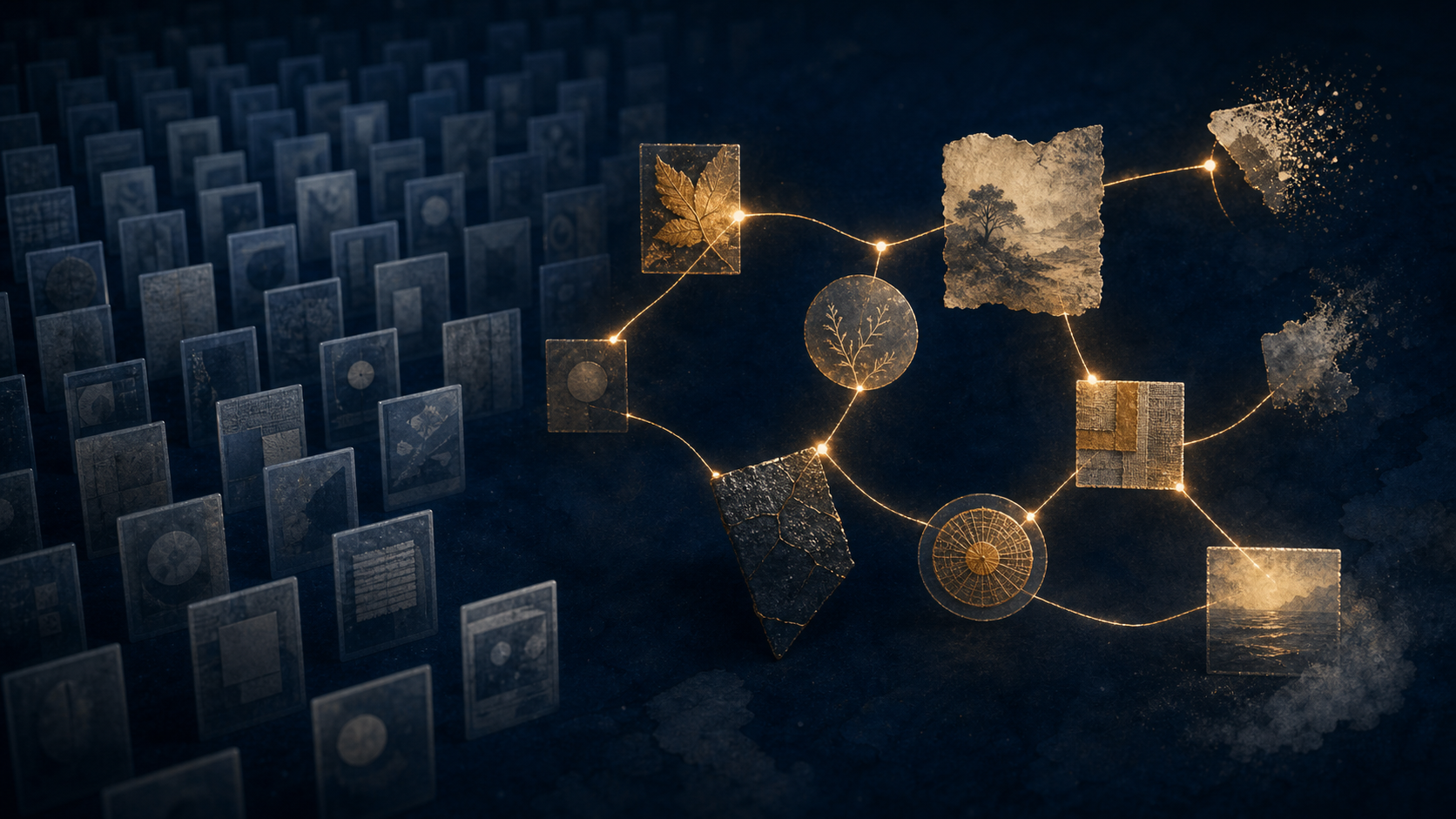
When I began building a personal AI memory system, I assumed I was solving a storage problem. I was wrong. The real problem was continuity: how to preserve not only what had been decided, but why it made sense at the time and what might make it wrong now.
I was working across more projects, conversations, and tools than I could reliably hold in mind. A useful correction made in one place might disappear inside a long discussion. A decision taken months earlier might return without the reasoning that produced it. Sometimes I could find the final answer, but not the path that made the answer sensible.
We already have more storage than attention.
Organisations preserve emails, presentations, meeting notes, messages, policies, reports, dashboards, recordings, and increasingly, conversations with artificial intelligence. Yet the same questions return. Teams repeat investigations. New leaders reopen matters that were settled for good reasons, or continue decisions whose original conditions no longer exist.
The information is usually somewhere. What is missing is the memory.
That experience forced me to confront the difference. Storage keeps material. Memory helps us understand why something mattered, how confident we were, what changed, and what the present moment requires from us.
That distinction is as important for institutions as it is for individuals.
The problem is not a lack of information
Most organisations do not suffer from too little documentation. They suffer from information that has been separated from purpose.
A report may explain what happened without recording which uncertainty worried the people making the decision. Minutes may capture the resolution but omit the disagreement that sharpened it. A dashboard may preserve the number while losing the operational event that made the number unusual. A policy may remain in force long after the problem it addressed has changed.
Over time, the record becomes larger while understanding becomes thinner.
This creates a familiar kind of organisational friction. Before acting, people must reconstruct the past from fragments. They search inboxes, ask colleagues, compare versions, and try to remember who was present. The cost is not only time. Each reconstruction introduces interpretation, and each retelling can quietly change the meaning.
An archive can tell us what exists. It cannot, by itself, tell us what deserves attention now.
A decision can outlive its reasoning
The result of a decision often travels farther than its reasoning.
Someone approves a new process, changes a supplier, limits access, delays an investment, or chooses one system over another. The decision enters a policy, a budget, or a workflow. Months later, people inherit the outcome as if it were self-explanatory.
It rarely is.
Every serious decision contains conditions. It rests on evidence available at the time. It reflects constraints, risks, assumptions, and sometimes an explicit acceptance of uncertainty. If those conditions disappear from the record, the decision can become either a rule no one feels able to question or a choice no one feels obliged to respect.
Both are failures of memory.
Continuity does not mean preserving every past decision unchanged. It means preserving enough of the reasoning to know whether the decision still fits the world around it.
This is why a useful institutional memory must record more than conclusions. It must keep the relationship between the conclusion and the circumstances that justified it.
Retrieval is an executive capability
Memory becomes valuable when it appears at the moment of decision.
It is not enough to know that a document exists somewhere. The relevant context has to be discoverable before a meeting, during an escalation, or when a familiar problem returns in a new form. Otherwise, the organisation behaves as if it has no memory at all.
This makes retrieval an executive capability, not merely a technical feature.
Good retrieval reduces the cost of re-understanding. It helps a leader see whether a problem is genuinely new, whether a proposed answer was tried before, and whether the conditions have changed enough to justify a different course. It can reveal a pattern across departments that each team sees only in isolation.
But retrieval must also earn trust. A result should show where it came from. It should distinguish a direct record from a later interpretation. It should make uncertainty visible rather than presenting every remembered fragment with equal authority.
Without that provenance, a confident answer can be more dangerous than no answer. It may feel complete while resting on a partial or outdated account.
The raw record and the curated memory
While building my own system, I found that neither extreme was sufficient.
Keeping only raw conversations preserved detail, but created too much noise. Keeping only polished summaries produced clarity, but risked smoothing away the hesitation, contradiction, and correction through which understanding had developed.
The useful design was to keep both.
The raw record preserves the evidence. The curated layer preserves the meaning we currently draw from it. The link between them allows a person to move from a concise account back to the source when the decision deserves closer scrutiny.
Organisations need the same relationship.
They need concise institutional knowledge that people can use without reading every underlying document. They also need a path back to the record, because summaries are judgments. They select, compress, and frame. Even a careful summary can become misleading if it is separated from its sources or treated as permanently complete.
The aim is not to eliminate interpretation. That is impossible. The aim is to make interpretation visible and revisable.
Forgetting is part of trust
A system that remembers everything may sound powerful. In practice, it can become careless.
Not every conversation deserves permanence. Not every early hypothesis should follow a person or a project indefinitely. Some information becomes obsolete. Some should be removed for reasons of privacy, dignity, security, or simple relevance.
Forgetting is not always a failure of memory. Sometimes it is evidence of judgment.
An institution should know what it retains, why, who is authorised to use it, and how long it should remain. Retention should be reviewed deliberately rather than inherited by default, and material that no longer serves a clear purpose should be removed. The same discipline applies whether the record sits in a filing cabinet, a cloud platform, or an AI-assisted knowledge system.
This matters especially as artificial intelligence makes it easier to capture and retrieve large volumes of conversation. The technical ability to remember something does not create an obligation to remember it forever.
Trust depends partly on restraint.
Artificial intelligence can assist, not decide
Artificial intelligence can help organise a large body of material. It can identify recurring subjects, connect related discussions, extract candidate facts, and bring relevant context into view. Used carefully, it can reduce the burden of searching and help preserve continuity across tools and teams.
But it cannot own the final judgment about what becomes institutional memory.
Significance is not merely a property of text. It depends on responsibility, consequence, timing, and human intent. A system may identify that a decision was discussed repeatedly, but repetition does not make the decision correct. It may produce a fluent summary, but fluency does not prove faithfulness. It may find a relevant precedent, but only people accountable for the present decision can determine whether the precedent still applies.
The role of the technology is to assist attention. The responsibility remains human.
This is the boundary I find most important. AI should help us recover context without quietly becoming the authority that defines it.
What should an organisation remember?
Building my own system led me to a practical answer. For any consequential decision, five elements are worth preserving:
- The decision itself. What was agreed, rejected, deferred, or changed?
- The evidence. What information materially influenced the decision, and where did it come from?
- The assumptions and uncertainty. What did we believe to be true, and what remained unresolved?
- The responsibility and time horizon. Who owns the outcome, and when should the decision be revisited?
- The path back to the source. Where can a future reader inspect the original record rather than relying only on a summary?
This is not an argument for documenting every minor choice. That would create another form of paralysis. It is an argument for treating important decisions as assets that deserve enough context to remain useful.
The discipline lies in choosing what merits that care.
Continuity without accumulation
I began this work because I wanted continuity across a growing number of projects and conversations. I did not want each new session to begin by reconstructing what had already been learned.
What I discovered was that continuity cannot be created by accumulation alone.
The purpose of memory is not to preserve the past in perfect detail. It is to help us meet the present with a more honest understanding of how we arrived here. It should reduce unnecessary repetition without trapping us inside old conclusions. It should make previous reasoning available without pretending that previous reasoning is final.
For leaders, this is not a minor administrative concern. Institutions repeatedly lose time, confidence, and judgment because the context behind their decisions is scattered across people and systems. When experienced colleagues leave, the loss is often described as a loss of knowledge. More precisely, it is a loss of relationships between facts, circumstances, and decisions.
Technology can help preserve those relationships. It cannot decide which ones deserve to guide the future.
Storage answers a simple question: Where did we put it?
Memory answers the harder ones: Why did it matter, what did we learn, and what should we do now?