
The question before the organization chart
You have joined a Saudi organization as a fresh graduate. During your first week, a senior manager asks you to assess Shared Services and return with a recommendation. The instruction may be only one sentence: “Tell us what should be shared and how we should organize it.”
Your role is not to decide law, accept risk, reassign authority, or compel another function. Your role is to assemble evidence, identify the people who own the facts and decisions, and route each unresolved question to the person authorized to answer it.
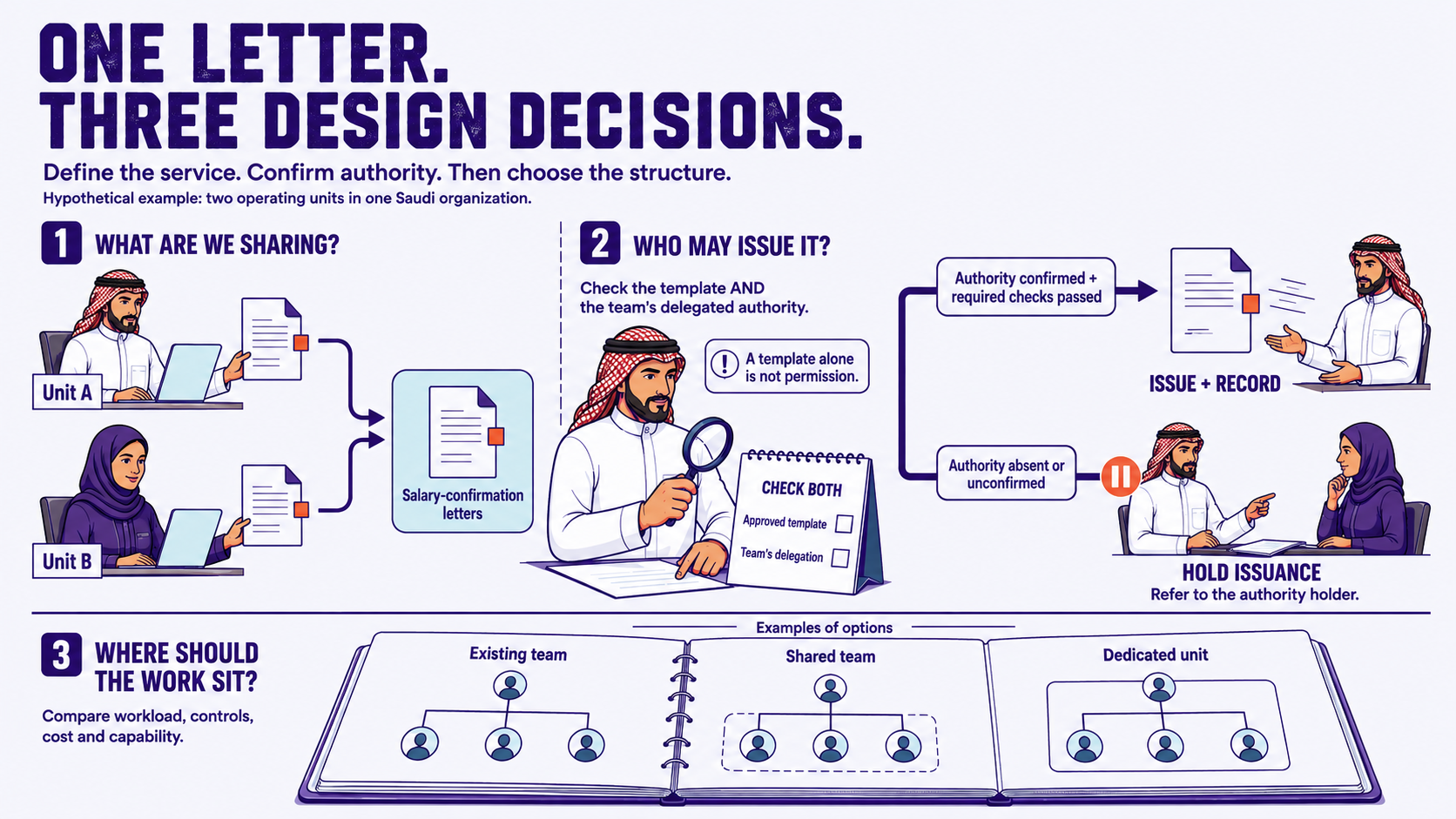
Before drawing a chart, take a familiar case: an employee requests an employment letter. The repeatable result is a service. A service customer is any intended recipient of that result. When the recipient sits inside the organizational boundary being assessed, it is an internal customer.
Our running example is hypothetical: a Saudi organization is considering a shared employment-letter service for two operating units within the same organization. Employees receive the letters directly; both units receive the organized service. We will follow a routine salary-confirmation letter and an exceptional letter requiring customized wording or a signature outside the signer's approved authority. No subsidiary structure is assumed.
Shared Services is a common arrangement through which multiple internal departments, business units, subsidiaries, or eligible government entities receive one or more defined services, or a related service family. Delivery may use internal staff, an external provider, or both. Sourcing remains separate from service ownership, authority, and controls. The arrangement might use a common process, platform, lead department, internal team, group unit, separate company, government instrument, or a deliberate combination. Its scope and form follow the work, service customers, business model, scale, risk, context, and authority required to run it.
Centralization describes where work or decisions are concentrated. Shared Services describes how a defined service is organized for multiple service customers, with clear authority and accountability. Execution can be centralized, distributed, or combined. Moving requests into one system or location does not establish that arrangement by itself.
Practitioner note: Years of building and leading Shared Services taught me to begin with the service and its authority boundary. The organization chart comes later.
Answer in 30 seconds
Shared Services is a common arrangement for multiple service customers to receive one or more defined services. This definition does not prescribe a centralized department, outsourced provider, or separate company. For design, assess the final placement service by service, settle its authority boundary, and choose the organizational form afterward.
Candidate services may come from Human Resources, Finance, Procurement, Information Technology, Sales, Marketing, Facilities, Safety and Security, Legal, or elsewhere. Shared Services may execute approved work, own defined decisions, or do both within documented limits. Use evidence to choose among the current arrangement, a common process or platform, a shared arrangement, and a bounded pilot. A bounded pilot is a temporary trial with a named scope, owner, measures, stop conditions, and safe return path: a way for the current provider to resume the service if the trial stops.
The decision
A whole department is usually too coarse for the final service-placement decision because one function contains different work and authority. A function-level scan can identify candidates. The executive decision concerns the selected service: keep its current delivery, apply a common standard, move it into a shared arrangement, or choose another course.
The first four steps turn a broad instruction into a traceable current-state assessment.
Step 1: Clarify the assignment and boundary
The sponsor is the accountable leader who requested the assessment, confirms its purpose, and removes major barriers. The boundary states which legal entities, business units, locations, services, decisions, systems, people, and period are included. It also names what is outside the work.
Ask the sponsor what decision is required, who will make it, when it is due, and why it is needed now, then confirm whether the organization is private, government, government-owned, a group, or another form. The assignment itself is your first evidence; obtain it in writing along with any mandate or delegation that establishes who may decide.
Create a local-validation register for questions about potentially binding obligations or reserved authority. For each question, record the evidence needed, accountable owner, status, due date, blocking effect, and escalation route. Do not convene every specialist for every service. Send a precise question only to the owner whose authority or evidence is material. Attach the register to a one-page assignment note containing the decision, boundary, owner, deadline, stakeholders, and exclusions. Escalate if no one can name the decision owner, if leaders conflict, if record access exceeds your authority, or if the assignment assumes an outcome such as “centralize everything.”
Use Section 3, “Assignment and authority,” and Section 5, “Evidence and local-validation registers,” in the companion Saudi Shared Services Starting Workbook to capture this output. Download the current workbook (editable Markdown) and the bilingual Services Ledger (Excel).
Two boundary cases change the assignment without removing the need for analysis. If an executive or government mandate has already decided that a shared arrangement will exist, do not reopen that authorized decision unless the sponsor asks. Use the method to define scope, retained authority, controls, implementation conditions, and unresolved risks. If the organization is new or the service has no usable case history, use documented demand assumptions, comparable internal records, and clearly labeled estimates. Unknowns that could affect authority, legality, control, or safe operation remain open until an accountable owner resolves them or operating evidence becomes available.
Step 2: Select one service and identify its service customers
Choose a result that a service customer can recognize: “employment-letter service” is useful, while “assess all of HR” is too broad. Write the trigger, expected result, start and end points, service customers, current owner, and explicit exclusions. A practical boundary might include receiving a complete request and issuing an approved letter, while excluding changes to employment policy or employee data that require separate authority.
Speak with the current service owner, two or more performers, and representative service customers. Ask for the service description, policy, request form, system record, and completed cases. Your output is a one-service definition and service-customer map. Escalate when stakeholders disagree about the result, the scope contains unrelated work, or the boundary would move a decision that nobody is authorized to reassign.
Record the result in Section 6, “Define the service and its service customers,” of the workbook, including the one-service definition and service-customer map.
Step 3: Establish the current baseline
A baseline is the documented starting point against which an option or pilot can later be compared. It should cover a stated period and a consistent service boundary. For the employment-letter service, collect requests by letter type and service customer, handling and waiting time, backlog, corrections, rework, service hours, staff effort, system usage, approved templates, and evidence of release controls. Record what the data cannot tell you.
Ask the service owner and performers for operating records, and ask the system owner how fields and timestamps are created. Finance validates cost scope and assumptions. Service customers can confirm whether logged cases represent what they receive. The deliverable is a baseline evidence register with source, owner, period, definition, quality, and limitation. Escalate conflicting records, unsafe access to regulated data, omitted retained cost, or an estimate presented as a measured fact.
Use Section 7, “Establish the current baseline,” for the baseline measures, evidence limitations, and confirmation record.
Step 4: Map normal work, exceptions, systems, controls, and decisions
Trace real cases. A handoff occurs when work or responsibility passes between one person, team, or system and another. An exception is a case that cannot follow the normal route because information, approval, risk, or circumstances differ. A retained decision is an authority that stays with a subsidiary, business unit, profession, policy owner, or accountable executive even when related execution becomes shared.
Sit with the people doing the work and follow several ordinary cases plus meaningful exceptions. For each case, mark the request channel, data entered, system used, checks performed, approvals, queues, handoffs, records created, service-customer communication, and escalation.
In our example, the routine salary-confirmation letter uses approved wording and verified employment data; its issuance must also be covered by delegation. The exceptional letter needs customized wording or a signature outside the approved delegation. Check the records for the actual letter type and the people who would issue it. Use decision verbs: detect, document, escalate, decide, execute, communicate, and monitor. This wording prevents a vague box called “owns process” from hiding who actually chooses an outcome.
Ask the process and policy owners to validate the formal path, and send specialist questions to the relevant owner in the local-validation register. Produce a current-state service map and responsibility map showing ordinary work, exceptions, controls, evidence, decisions, and unresolved ownership. Escalate conflicting authority, a control bypass, an unowned exception, or any request for you to interpret law, waive a control, or accept risk.
Use Section 8, “Map current work, exceptions, and responsibility,” for the ordinary-case trace, exception trace, and responsibility maps.
First-week checkpoint
- Obtain the written assignment and decision owner.
- Define one service and its service customers.
- Request the essential records for a stated period.
- Trace one ordinary case and one exception.
- Record open questions, owners, and blocking effects before drawing a structure.
Seven-Lens Department Existence Test
Step 5: Apply the Seven-Lens assessment
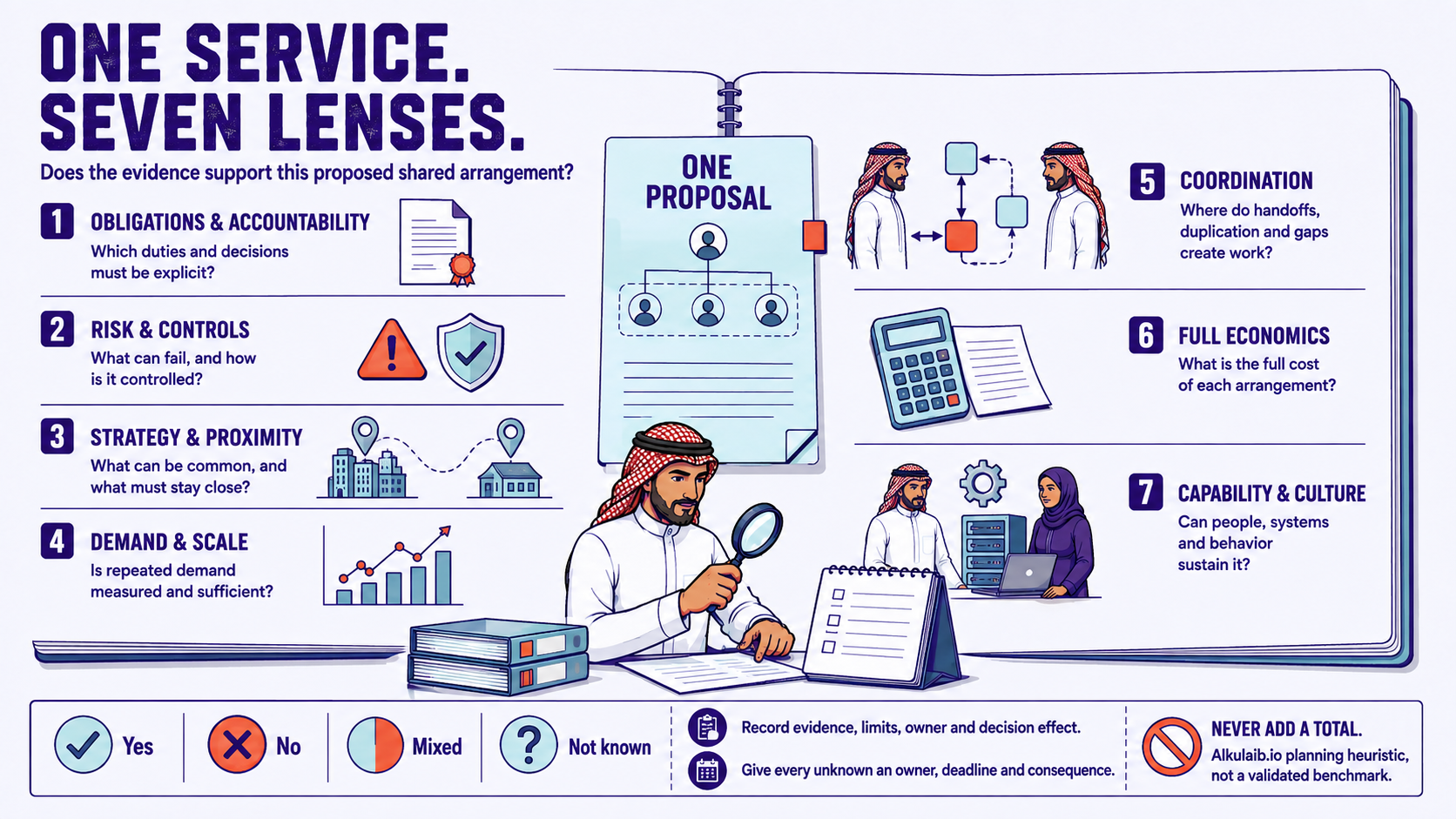
The Seven-Lens Department Existence Test is an Alkulaib.io planning heuristic that organizes evidence and judgment; it is not an externally validated benchmark, maturity model, legal test, or automatic recommendation. Law, regulation, delegated authority, security, duty of care, and control obligations can override the heuristic.
Before applying the lenses, sketch realistic ways to deliver the defined service. For the two units, compare common templates and controls with local execution against a team serving both units. State the proposed service and authority boundary for each. These are preliminary alternatives to test; Step 6 uses the findings to compare authority configurations and organizational forms.
| Lens | Question to answer | People and evidence |
|---|---|---|
| 1. Regulatory and accountability necessity | Which obligations, accountable ownership, reserved authorities, or decisions must be explicit? | Sponsor, Legal, Compliance, policy owner, sector specialists; current official requirements, delegations, policies, licenses, audit findings |
| 2. Risk and control exposure | What can fail in the current arrangement and under each proposed arrangement? | Risk, Audit, Privacy, Cybersecurity, Safety, Finance, service staff; incidents, access records, control tests, complaints, continuity evidence |
| 3. Strategic fit and differentiation | Which parts support a common strategy, and which need proximity to a service customer, market, profession, site, or entity? | Business leaders, functional specialists, service customers; strategy, decision records, variation reasons, service-customer and site constraints |
| 4. Scale and repeatable demand | Is demand repeated, defined, measurable, and sufficient to justify common organization? | Service staff, Planning, Finance, system owner; request volumes, seasonality, time samples, exception mix, backlog |
| 5. Coordination complexity | Where do duplication, handoffs, reconciliation, escalation, dependencies, or ownership gaps create work? | Performers, service customers, process and system owners; process traces, queues, duplicate records, rework, unresolved cases |
| 6. Current-delivery versus shared-delivery economics | What is the full comparable cost and effort of the current and proposed arrangements? | Finance, service owner, Human Resources, Technology, Procurement, Tax; people effort, systems, suppliers, retained work, transition, controls, governance, reversibility |
| 7. Capability maturity and culture | Can the people, process, data, systems, sponsorship, governance, and behavior sustain the proposed arrangement? | Sponsor and every accountable owner; process quality, data quality, capacity, capability, dependencies, open risks, change evidence |
Two candidates people often propose as additional lenses are business proximity and readiness. Business proximity belongs inside lens 3 and readiness inside lens 7; neither becomes an eighth lens.
Every lens tests the same proposition: within this lens, the evidence supports placing this defined service in the proposed shared arrangement under the stated conditions. Record Yes when the evidence supports that proposition and No when it opposes it. Use Mixed when the result differs by service customer, case, period, or activity, and Not known when the evidence is insufficient. Treat each lens result as a reasoned conclusion from its questions, not the answer to one convenient question. Record the evidence and period, its limitation, the accountable owner, recommendation effect, escalation route, and decision date.
Do not add the answers into a total score. Resolve them in this order:
- Lenses 1 and 2 expose binding obligations, authority, and material risk. A binding obligation, missing authority, or unmitigated material risk can block or condition implementation. A No label by itself is not an automatic veto; the evidence and decision effect are what matter.
- Every Not known response needs an owner, deadline, recommendation effect, and escalation route. If it concerns a potentially binding requirement or reserved authority, hold the affected implementation until the responsible specialist or authority holder resolves it. Operational gaps may require more evidence, a narrower proposal, or deferral; if they prevent readiness from being established, the affected pilot must also wait.
- Lenses 4, 5, and 6 establish the operational and economic case through demand, coordination burden, and full comparable economics.
- Lenses 3 and 7 shape the boundary, organizational form, and pace through strategic proximity, differentiation, capability, systems, sponsorship, and behavior.
Practitioner note: I treat a documented No differently from Not known. A No gives the decision owner evidence to weigh. Not known means the evidence required for a responsible decision is still missing.
The decision brief must say which findings support the arrangement, which oppose it, which impose conditions, and which remain unresolved. It must not count labels.
Record the assessment in Section 9, “Seven-Lens worksheets,” including the evidence, limitation, owner, escalation, and synthesis for each lens.
A worked trace: the employment-letter service
This example demonstrates the method; it does not assert facts about a real organization. Replace every entry with dated local evidence.
| Lens | What the analyst does and what the result means |
|---|---|
| 1. Regulatory and accountability necessity | Check the approved wording, authoritative employment record, and whether issuance delegation covers the proposed team's members and the specific letter type. Confirm with the relevant authority holder. Unverified delegation coverage is Not known and holds affected issuance. |
| 2. Risk and control exposure | Inspect completed letters, correction cases, access permissions, release checks, and complaints. A Mixed result may support routine cases while keeping sensitive or unusual cases outside the shared boundary. |
| 3. Strategic fit and differentiation | Test whether routine letters can follow one standard while policy interpretation, employee relations, and exceptional wording remain with the employing entity or authorized Human Resources owner. A Mixed result can support a standard routine path while retaining judgment-heavy work with the local owner. |
| 4. Scale and repeatable demand | Count requests by type, service customer, period, peak, rework, and turnaround. Record Not known until the evidence register contains those observations; a Yes supports common organization only when demand is repeated and sufficiently measured. |
| 5. Coordination complexity | Map duplicate templates, approvals, handoffs, system lookups, corrections, and escalation across service customers. A Yes can strengthen the case for a shared arrangement when the coordination burden is material; a No may favor a smaller process fix. |
| 6. Current-delivery versus shared-delivery economics | Compare current effort with proposed delivery, including retained approval, system access, controls, transition, and exception handling. A No means the full comparable economics oppose the proposal; a Mixed result may support a narrower boundary or pilot. |
| 7. Capability maturity and culture | Test the request channel, master data, templates, owners, access, controls, staff capability, sponsor, and return path. A No or Not known result requires a stated consequence: if readiness cannot be established, the affected pilot waits. |
For the routine letter, confirmed delegation coverage supports issuance by the proposed team within that scope. Confirmed exclusion means No for issuance under current authority. If coverage cannot be verified, record Not known and hold issuance until the authority holder resolves it. The approved template alone answers none of those delegation questions.
That finding does not settle the whole first lens: other obligation or accountability questions may remain open. Capacity, data quality, and full comparable economics require their own evidence. Issuance authority can be confirmed while operating readiness remains unknown, in which case the pilot waits.
If records show that inconsistent templates cause errors while each unit can handle its demand, a common process with local execution may be preferable. Duplicated processing, or a backlog in one unit alongside unused capacity in the other, may favor a shared team. Test those explanations against the cases, retained local work, control needs, transition cost, and full comparable economics. Pooling work alone proves no saving.
The recommendation may therefore favor a routine-letter pilot, shared templates and a request channel with local execution, a narrower process repair, or no change. Each conclusion must identify the evidence that supports it and what could change it.
Compare ways to organize the service
Step 6: Compare authority configurations and organizational forms
Start with authority because the same service can require very different organizations depending on who may decide.
| Configuration | What it means | What must be tested |
|---|---|---|
| A. Execution-only | Shared Services performs defined transactional work. Policy, priorities, material approvals, and exceptions remain with named accountable owners. | Whether the handoff is efficient, retained decisions are available on time, and execution controls are sufficient |
| B. Delegated authority | Shared Services owns written standards, routine approvals, operating decisions, or defined exceptions within limits. | Delegation, competence, controls, records, independent challenge, and escalation outside the limit |
| C. Enterprise operating portfolio | Shared Services controls material priorities, resources, policies, cross-entity coordination, or operating decisions. | Enterprise mandate, risk, governance, executive access, portfolio capacity, and accountability across entities |
These are alternatives, not stages in a maturity ladder. Shared Services can own decisions in configurations B and C, and it may own selected decisions even when much of the service remains locally delivered. The authority must be real, documented, and compatible with applicable obligations.
For employment letters, configuration A could let Shared Services prepare routine salary-confirmation letters using approved wording and verified data. Issuance still requires delegation covering the letter type and the people issuing it. Configuration B could delegate routine approval within written limits while retaining exceptional wording with Human Resources. Configuration C concerns a broader operating portfolio; one routine letter service does not establish that scope.
Compare each realistic configuration with the current arrangement. Ask the sponsor, current owner, affected business leaders, and relevant owners in the local-validation register what authority would move, what would remain, which risks change, and how the decision could be reversed. Use delegations, policy ownership, exception records, current reporting lines, control evidence, and the service maps to produce an options comparison. Escalate if an option assumes authority that cannot be delegated, hides a control owner, or lacks a credible return path.
Then compare forms without treating any one as the destination. A service can use a common process or platform, a lead department, internal team, department, division, second-level unit within another function, executive portfolio, group unit, separate company, government instrument, or a combination.
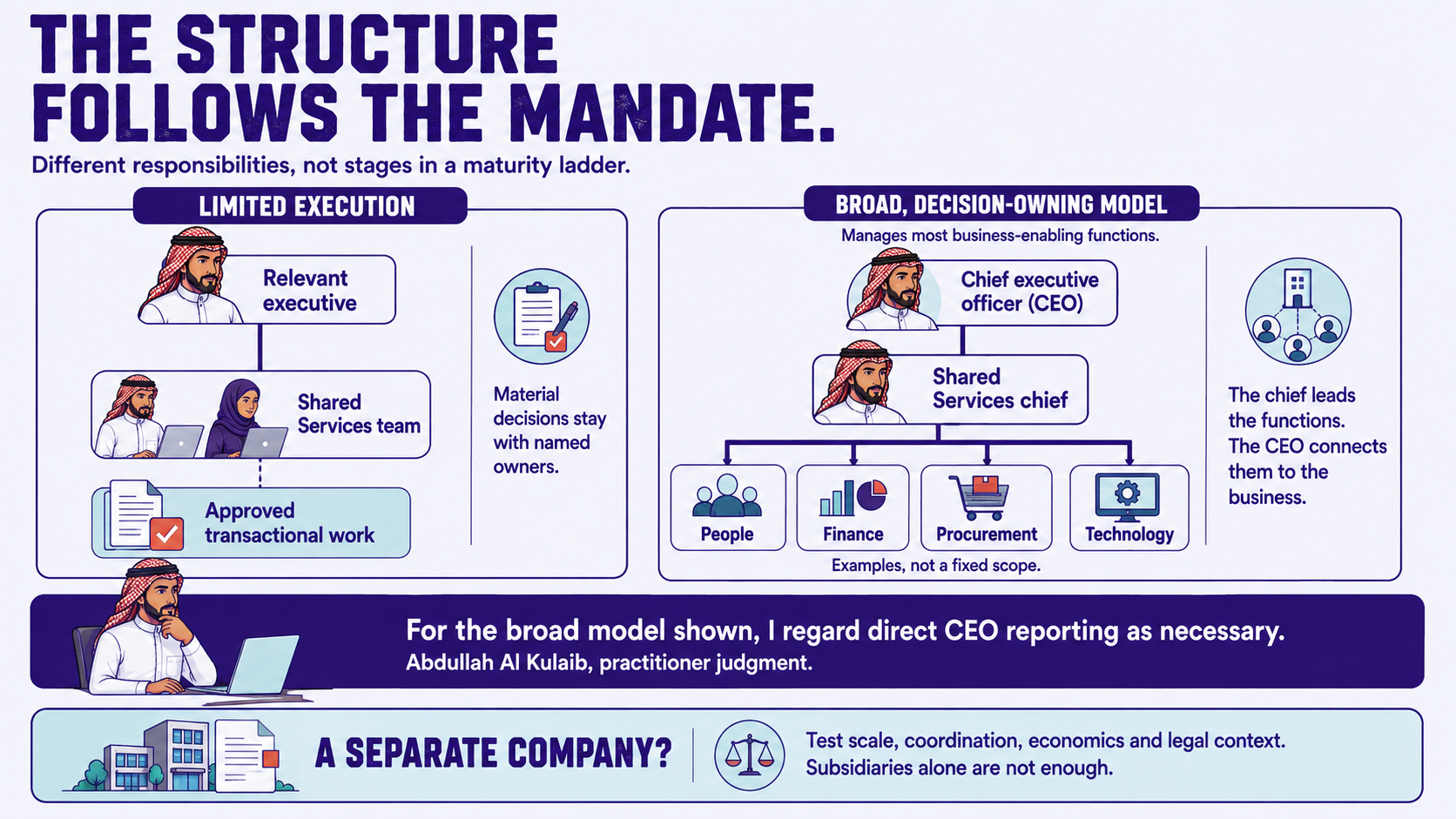
Practitioner note: When Shared Services manages most of the functions the business depends on, such as Human Resources, Finance, Procurement, and Information Technology, and makes decisions about their priorities and resources, its chief carries their operating leadership. In this model, I regard direct reporting to the chief executive officer (CEO) as necessary.
Placing another Chief Operating Officer over the same responsibilities duplicates executive accountability. The Shared Services chief manages the constituent departments and resolves matters within the role's authority. The CEO connects their plans and capabilities to business priorities and settles matters beyond that authority. This is a continuing leadership relationship, not only an escalation route; the CEO does not run those departments day to day.
A limited execution-only service can sit under a Chief Operating Officer or another executive with the appropriate remit. The direct-reporting judgment concerns the broad, decision-owning model described above. It is not a rule for every Shared Services title or a claim about how prevalent the model is in Saudi Arabia.
Multiple subsidiaries alone do not justify a separate company. Consider the work, workforce, project size, transaction and coordination volume, independent contracting needs, intercompany complexity, controls, authority, legal context, and business model. The output remains an options comparison at this stage, not the final operating-model decision reserved for a later article.
Use Section 11, “Compare authority alternatives,” and Section 12, “Compare organizational forms,” to record the comparison and the reasons behind it.
Who owns the service and how decisions are made
Step 7: Define shared scope, retained decisions, controls, measures, escalation, and exit
Turn the preferred option into a draft service boundary. State the service and service customers, entry requirements, exclusions, decision rights, retained responsibilities, controls, escalation route, measures, dependencies, and exit conditions. The output is a boundary statement precise enough for accountable owners to approve, reject, or return for more evidence.
Ask the sponsor and current service owner to confirm accountability, and ask representative service customers whether the result and their obligations are clear. Send specialist questions to the accountable owner already named in the local-validation register. Use the authority map, policies, delegations, service map, control records, service-customer obligations, and system constraints as evidence.
Produce a draft service-boundary and governance statement. It should say who requests, who performs, who decides each material question, who is accountable for the result, how an exception travels, and who may stop or reverse the arrangement. Escalate if a decision has two owners or no owner will accept accountability. Also escalate if the proposed executor lacks access or capability, or if an exit condition depends on data, records, knowledge, or people that cannot be returned safely.
For the employment-letter service, state who validates the employee record, owns the approved wording, and may sign or release each letter type. Then name which cases leave the routine path, who contacts the employee, and where the final letter and decision record are retained. If those sentences cannot be completed, the service is not ready for an organizational recommendation.
Use Section 13, “Draft the service boundary,” to record the proposed service, exclusions, decision rights, retained responsibilities, controls, escalation, measures, and exit conditions.
Reference: Designing the arrangement
Steps 1 through 7 produce the evidence. The next six sections are reference material you will draw on while doing them and while preparing the Step 8 recommendation.
Services and scope
Function names are useful for finding candidate services, although they do not define Shared Services or turn the examples below into anything beyond hypothetical boundaries drawn from practitioner judgment. The examples show how execution and authority might be separated; they do not prescribe a scope for another organization.
| Function | Possible shared boundary | Possible retained boundary |
|---|---|---|
| Human Resources | Personnel administration, payroll execution, employee records, and routine service requests | Talent acquisition decisions, organization change, workforce judgment, and strategic Human Resources decisions |
| Finance | Accounting, bookkeeping, transaction processing, and routine financial records | Investments, borrowing and financing decisions, capital allocation, and strategic finance decisions |
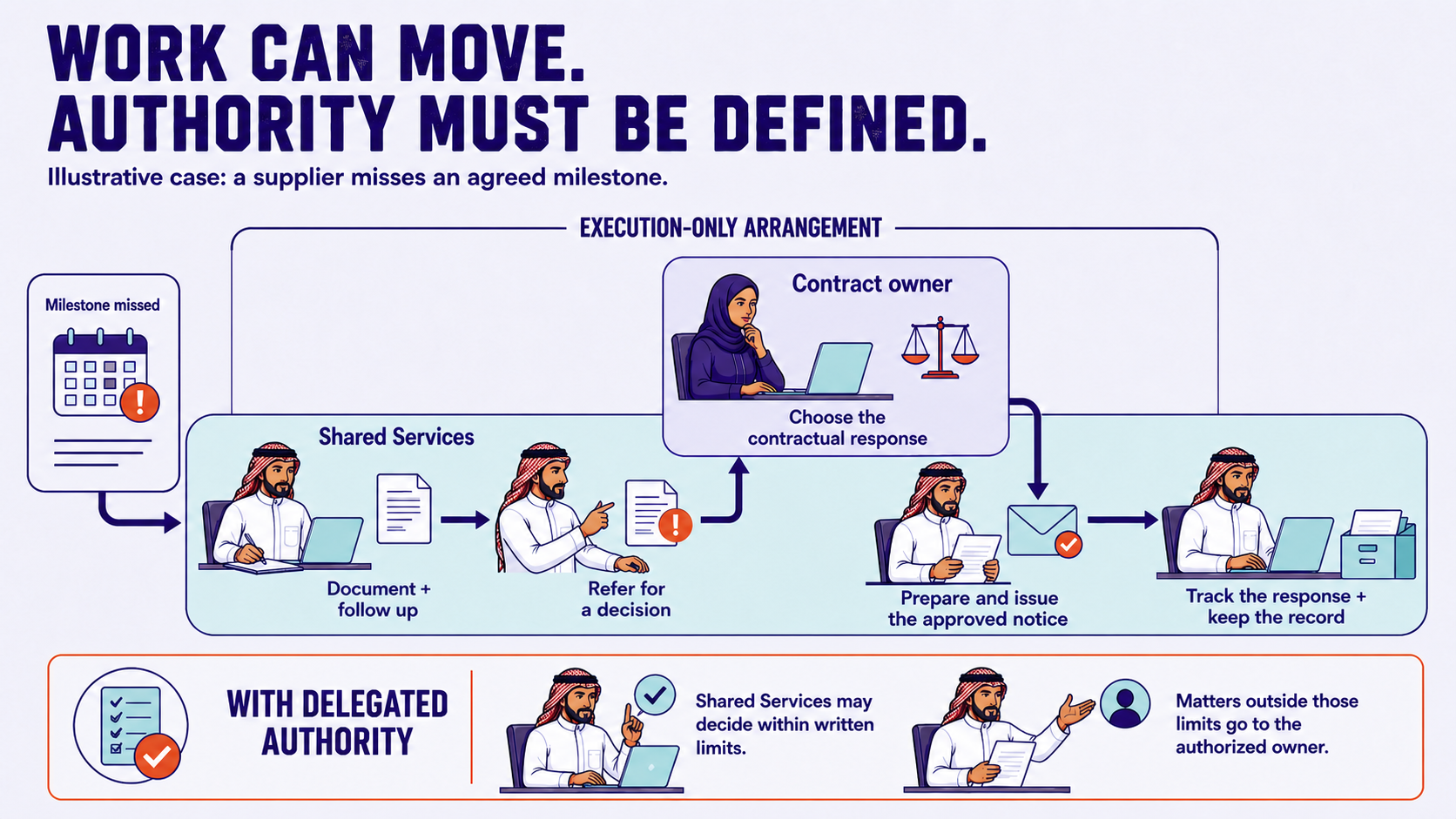
| Procurement | Post-award contract administration, obligation and milestone tracking, renewal and expiry records, supplier follow-up, and approved notices | Contractual response, claims, changes, termination, settlement, and other decisions held by the authorized subsidiary or contract owner |
| Legal | Legal-operations administration, including matter intake, document control, billing coordination, and records | Negotiation, litigation, legal strategy, and multi-jurisdiction legal judgment by qualified owners |
| Sales | Shared back-office support across subsidiaries or product lines, including quotation preparation using approved prices, terms, and authority limits; order administration; system entry; fulfillment and invoicing coordination; and sales records | Pricing, discounts, negotiation, customer commitments, account strategy, and commercial judgment |
Information Technology, Marketing, Facilities, and Safety and Security are also candidates when a defined service, service-customer group, authority, evidence, and suitable form can be established. The list is open by design.
Procurement is a useful second illustration of authority. If a supplier fails to perform, Shared Services can detect the failure, document it, escalate it, wait for the authorized decision, execute the approved action, communicate it, and monitor the result. In an execution-only boundary, the subsidiary or contract owner decides the contractual response while Shared Services may prepare and issue an approved notice, follow up, and retain the record. A different arrangement may delegate defined decisions when the authority, competence, controls, and escalation are documented.
Public Saudi reporting illustrates that possible scope can be broad. The Supporting Units section of stc's 2024 Annual Report names Human Resources, Training, Supply Chain, Procurement, Facility Management, Safety and Security, Business Partnering, Office Automation, and Local Content within its Shared Services Unit. That is a first-party description of one internal unit, not a market rule.
The Public Investment Fund (PIF) TASAMA page names Finance, Human Resources, Procurement, and Legal services within one service pillar, and strategic marketing within another. It illustrates TASAMA's stated scope, not a requirement to move entire functions.
Organization and role sequence
Organization follows the service and authority design. Build a role sequence before drawing reporting lines: service customer, request receiver, performer, checker, decision owner, accountable service owner, control owner, and escalation forum. For employment letters, name who validates employee data, who selects or approves wording, who releases the letter, who decides an exception, and who owns the result. The output is one role sequence with no competing owner for the same decision.
Saudi examples show that several forms are possible. On its leadership page accessed 28 August 2026, PIF lists Bander A. Mogren as “Chief Operating Officer and Head of Shared Services Division.” The combined title is one dated example of senior operating and Shared Services leadership in a single role, not a prevalence finding.
PIF says TASAMA was established in 2025 as a wholly owned PIF company following integration of the Business Incubation and Acceleration Company and the PIF Shared Services Center. It illustrates a separate-company form in one PIF context, not a reason to incorporate whenever subsidiaries exist.
The Saudi Shared Services Program illustrates a government instrument. Its official establishment page says the program was established under Cabinet Resolution No. 276 dated 1444/4/14H to provide shared services to government entities wishing to receive them. Its official services page names six service families: Human Resources; Procurement; Finance; Information Technology and Digital Transformation; Administrative Services and Facilities Management; and Audit. These pages are program summaries, so the operative authority must be checked before a real decision.
How recurring work is performed and checked
At design stage, repeat the Step 4 trace for one ordinary employment letter and one meaningful exception. Compare the proposed map with each case record and correct the map wherever the record differs. The output remains a normal-case trace and an exception trace that expose where work waits, where data is re-entered, and where authority is unclear.
Data, technology, and automation
Describe the capability before discussing products. For employment letters, identify the authoritative employment record and the fields permitted in each letter type. Record the approved template, request channel, access rights, approval and release history, and continuity method if the channel or system fails. The output is a one-page data and technology note showing the authoritative source, data flow, access, integration, audit record, recovery, and owner.
The National Center for Government Resources Systems says its Unified Government Resources Planning system covers Finance, Human Resources, Procurement, and Supply Chains through a central electronic core. It identifies government entities included in the State's general budget as the organizations served, and names functional departments and employees as beneficiaries. This supports the stated platform scope and beneficiary groups, not a Shared Services authority model.
Practitioner note: In my view, a platform can support common work, reporting, and connected systems without deciding who owns the service or approves an exception. I standardize the service first, digitize stable work, connect the required systems, automate suitable steps, and consider artificial intelligence only when its purpose and controls are clear.
For the letter service, digitization means submitting, recording, and tracking the request electronically. Automation means the system performs a defined step, such as sending a status notification under approved rules. Neither change by itself gives the system authority to approve or issue a letter.
How performance and service commitments are measured
Turn each proposed measure into a small definition card: name, purpose, numerator, denominator, start and end event, population, exclusions, period, source, owner, limitation, and decision use. For employment letters, useful candidates might include complete requests received, turnaround from complete request to release, first-time-correct letters, reopened cases, and exceptions by reason. The output is a measure dictionary, not a list of targets. Do not set a target until the baseline and definition are stable.
Staffing and budget
Start with the annual workload for the defined service. State which activities the measured minutes include, such as request handling, rework, and review, and what remains with other owners. Express the result in full-time equivalents (FTEs): the capacity of full-time people over the stated period.
Operational capacity (FTE) = annual workload minutes ÷ annual productive minutes per full-time person
Both sides use the same annual period. The result covers the work included in the calculation; it is not the final number of positions required.
Productive minutes are the time actually available for that work. Explain how leave, training, and other unavailable time affect the estimate. If already reflected there, do not add them again as a separate staffing allowance. Likewise, count supervision, specialist review, controls, and transition work separately only where they were not already included in workload. Distinguish ongoing work from temporary effort.
Test coverage and peaks separately. Enough annual capacity does not guarantee the right people and skills during every service hour or absence. Compare demand patterns with available shifts and skills, then explain any additional capacity needed instead of automatically adding allowances.
Ask the service owner and relevant workforce or Human Resources owner to validate workload and productive-time assumptions, and Finance to confirm the comparable cost boundary, including retained work and transition cost. Produce a capacity and cost note showing the assumptions, their owners, and how changes would affect the result. It is not a promised headcount reduction.
Implementation roadmap
Step 8: Make a bounded recommendation
Bring the outputs from Steps 1 through 7 into one decision brief. Start with four short lists: findings that support the proposed boundary, findings that oppose it, conditions that must be met, and questions still unresolved. Then compare the current arrangement, the smallest credible alternatives, the authority options, and the plausible organizational forms. Recommend a bounded pilot, another option, a targeted process or platform fix, more evidence, or no change.
Before a pilot starts, the decision owner agrees its success criteria against the baseline and service requirements. Separate the improvement sought, such as shorter turnaround, from conditions that must remain satisfied, such as correct letters and valid issuance authority.
For our example, a bounded pilot might cover routine salary-confirmation letters for a stated employee group and period. It uses approved wording, verified data, and confirmed issuance authority; customized letters remain outside its scope. Name the owner, measures, stop conditions, and the records, operating knowledge, and access the original provider needs to resume the service safely.
If turnaround improves but accuracy deteriorates, assess both against the agreed criteria. The decision owner determines whether to continue, adjust, narrow, or stop the trial, records the reason, and follows its stop conditions. One improved measure does not establish success.
Route unresolved specialist questions through the sponsor to their named owners, and route the decision brief to the authorized forum. Stop if a material prerequisite remains open, an accountable owner rejects the evidence, live work would change without approval, or the arrangement cannot be reversed safely.
Use Section 14, “Recommendation, no-change option, and bounded pilot,” to prepare the one-page decision brief and record any pilot or no-change recommendation.
Change and adoption
Prepare a one-page change-impact note for the selected option. Record who experiences a different request channel, role, approval, system, measure, or escalation; what stays unchanged; what people must learn; who supports them; and how the organization will detect workarounds or service failure. For employment letters, test the message and training against both a routine request and an exception. Do not begin a transition with unreviewed employer effects, unsupported authority, or an expectation that staff run two models without capacity.
Failure modes
Practitioner note: From practice, I have learned not to let the organization chart, platform, or promised savings become the answer before the service and its authority are defined. I reverse that sequence: define the service first, establish the authority boundary, and choose the organizational form afterward.
Several early errors can invalidate the assessment:
- A department list substitutes for service analysis. Recovery begins by selecting one result and its service customers.
- Interviews become the only evidence. Test descriptions against records and real cases for a stated period.
- Routine work and judgment-heavy decisions move together because they share a function name. Rewrite the boundary using decision verbs.
- An external provider is chosen before service ownership, authority, and controls are defined. Return to the service decision; sourcing remains separate.
- A platform becomes the answer while ownership and controls remain unclear. Return to the authority and service maps.
- A separate company is assumed because subsidiaries exist. Compare smaller forms and the real scale, work, authority, economics, and legal context.
- Savings appear before comparable scope, retained work, and transition cost have been established. Send the model back to Finance.
- A pilot lacks stop and return conditions. Do not start it until records, knowledge, access, and work can be returned safely.
- A public example is treated as a prescription. Restore the issuer, context, and limitation beside the claim.
- An analyst is asked to decide legal applicability, accept risk, move staff, commit funds, or change live operations. Escalate to the authorized owner.
Builder's Kit
- Download the bilingual Services Ledger (Excel)
- Download the English Starting Workbook (editable Markdown)
- Download the Arabic Starting Workbook (editable Markdown)
The Excel file is the service intake and capacity ledger. The workbook supplies the detailed assessment templates; open the Markdown file in a Markdown editor to complete a copy.
The companion Saudi Shared Services Starting Workbook accompanies this article. Use it alongside the method rather than treating it as a separate assessment.
Start with the assignment and boundary sheet, one-service definition, baseline evidence register, process and exception map, and Seven-Lens worksheet. Finish with the one-page decision brief. A blank field that applies to the assessment signals missing evidence or a decision. If a field is confirmed not applicable, record that and the reason. Uncertainty about applicability remains an open question, with an owner, deadline, recommendation effect, and escalation route. The workbook does not replace accountable approval or qualified advice.
Jurisdiction and industry note
This is a cross-sector introduction for Saudi Arabia. In government settings, a government entity receiving services from a government program may be better described as a beneficiary or recipient. The word customer can imply a commercial buyer-seller or chargeback relationship that may not exist. The organization's legal form, sector, regulator, workforce, systems, data, contracts, service customers, and delivery boundary determine what must be validated locally. Use the local-validation register defined in Step 1 and refer each issue to its accountable owner. A recommendation can be conditional on resolving a potentially binding question, but the affected implementation remains on hold until the responsible specialist or authority holder resolves it. This applies to questions about legality, delegated authority, regulated data, cyber risk, safety, financial control, employment, procurement, audit, or licensed responsibilities. Operational gaps follow the readiness rule in Step 5.
Six Saudi validation triggers
These are questions for accountable owners, not legal conclusions for the analyst to make.
| Trigger | Question to route | Accountable owner and evidence |
|---|---|---|
| Personal data across entities | What personal data would cross an entity boundary; which entity determines the purpose and means; who processes on whose behalf; and what lawful basis, disclosure condition, notice, access, retention, or agreement is required under the Personal Data Protection Law and Saudi Data and AI Authority (SDAIA) guidance? | Privacy or data-protection owner with Legal, data owner, a data-flow map, role analysis, approved basis, and required agreement or control |
| Cybersecurity across a shared platform | Which National Cybersecurity Authority (NCA) controls, sector controls, Digital Government Authority standards, or contractual controls apply to the actual entities and systems; and how will access, segregation, logging, incidents, continuity, and evidence be managed? | Cybersecurity owner with a written applicability decision, architecture, control map, test evidence, and accepted residual risk |
| Value Added Tax (VAT) and intercompany charging | Are intercompany service charges subject to VAT; are the entities members of one approved VAT group; and what invoicing, transfer-pricing, accounting, and audit evidence is required? The Zakat, Tax and Customs Authority (ZATCA) VAT Implementing Regulations and VAT Registration for Group service are starting points, not a ruling on the proposed arrangement. | Tax and Finance owners with the entity map, transaction model, VAT-group status, charging method, invoices, and documented treatment |
| Employee and social-insurance transfer | If people move to another employing entity, what service-transfer or contract process on the Ministry of Human Resources and Social Development (HRSD) Qiwa platform, employee action, and General Organization for Social Insurance (GOSI) registration change is required for each employee category? | Human Resources, Legal, government-relations, payroll, and social-insurance owners with the employer map, employee categories, contract status, approvals, and transition controls |
| Saudization and Nitaqat | How would a new entity, commercial registration, activity, workforce mix, profession classification, and documented contracts affect its classification under Nitaqat, HRSD's Saudization program? Use the current HRSD Nitaqat calculator for the actual facts rather than importing a ratio from another organization. | Human Resources, Legal, compliance, and government-relations owners with current HRSD rules, entity records, workforce data, calculator result, and documented decision |
| Government procurement | If a covered government entity is involved, how does the current Government Tenders and Procurement Law affect competition, approvals, contracting, records, supplier action, and execution? | Government procurement, Legal, Finance, and contract owners with an applicability decision, delegation matrix, procurement file, and exception route |
Sources and method
The Saudi examples use linked first-party or official sources. They establish what an issuer reported or what an official source requires readers to examine; they do not establish market prevalence, superior performance, transferability, or the answer for another organization. The service-level definition, distinction from centralization, functional boundaries, authority and reporting judgments, form criteria, capacity assumptions, and procurement sequence are Abdullah Al Kulaib's practitioner positions. The Seven-Lens method is an Alkulaib.io planning heuristic. Neither it nor the illustrative examples are official definitions, external benchmarks, or legal conclusions.
What you can now take back to the sponsor
You began with a one-sentence assignment and a blank organization chart. You can now return to the sponsor with one defined service, a trace of how it works, the unresolved questions, realistic authority and form options, and a bounded recommendation naming who must decide. That is the first credible answer: a traceable service decision. Only then should accountable leaders approve the chart, with its boundary, authority, controls, and conditions.
Next article
Article 2 develops the business case begun here before the organization chart is approved. It will test whether the service problem is worth solving, compare the current arrangement with realistic options, include retained work and transition cost, and define what evidence would justify a bounded pilot.