
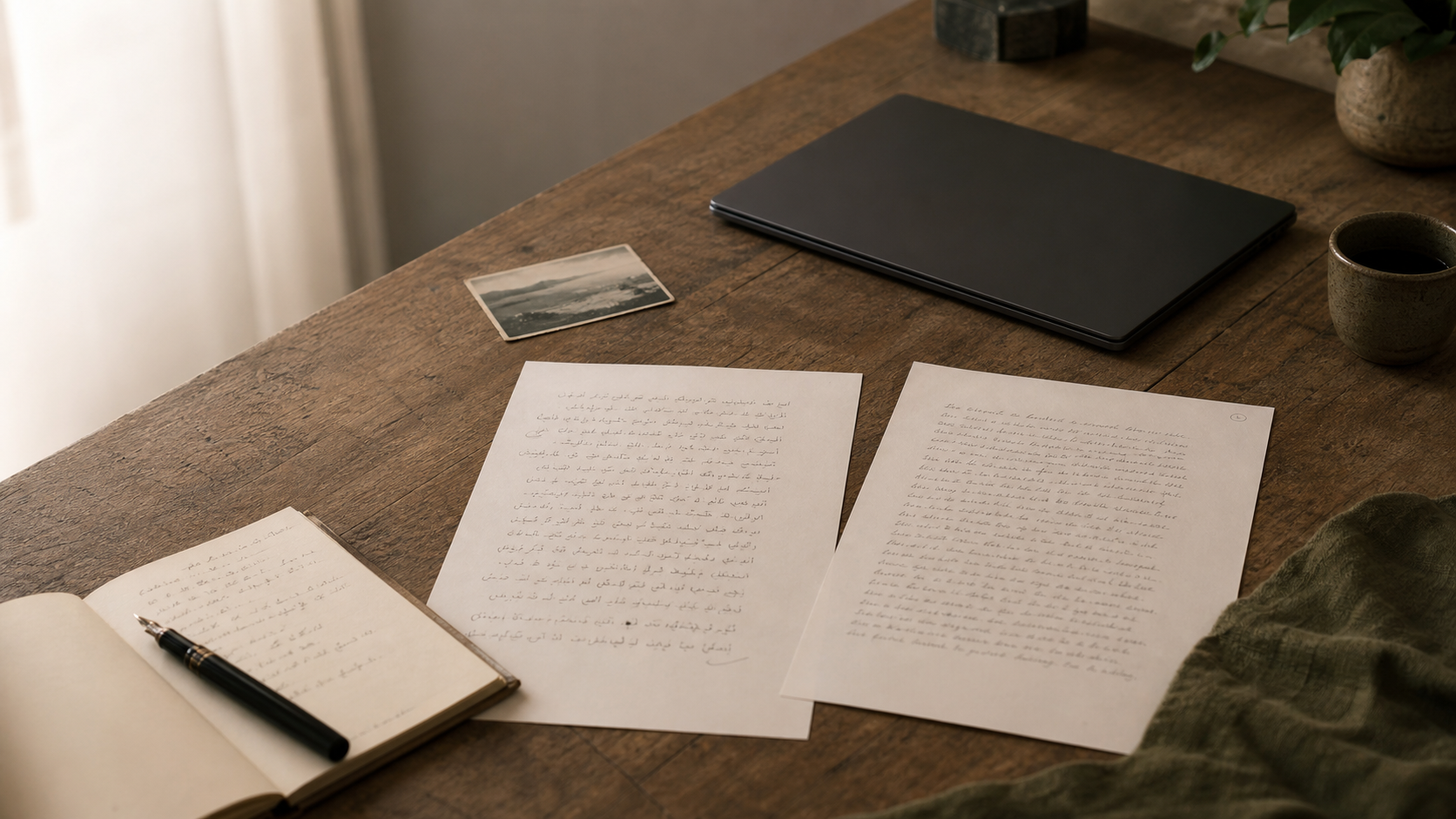
The more I worked on my own website, the more I realised I was not simply designing pages. I was trying to build a way of working in public.
A personal website is often treated as a better-looking resume: a place for previous roles, education, projects, photographs, and a way to get in touch. All of that has its place. But it does not explain how a person thinks, what they are paying attention to now, or what they are still trying to understand.
That is the limitation of a resume. It records a route already travelled. It does not leave much room for the work that is still taking shape.
I have come to see a personal website differently. It can be an operating system for attention: a way to decide what to preserve, what to share, what to return to later, and what needs more thought before it becomes public.
The part people see is only the surface
Visitors see the visible layer: a short introduction, a few ideas, an article, a photograph, perhaps a timeline of work.
Behind that is a quieter kind of work. Choosing what belongs and what does not. Writing honestly without turning the site into a catalogue of achievements. Preparing ideas in more than one language. Keeping drafts, images, and published pieces organised. Making sure that something worth keeping does not disappear because it was left in the wrong place.
That invisible layer matters to me because it resembles work I have done throughout my career. In different organisations and industries, I have often been drawn to the operating foundations: the way decisions move, services are delivered, responsibilities connect, and complexity becomes manageable.
The setting changes. The work underneath is often recognisable.
A public website has its own operating foundations. If they are weak, the surface will eventually show it.
Tools need a job
We have more ways than ever to capture and publish an idea. Notes can be saved instantly. Conversations can become research. Artificial intelligence can help explore a question, organise material, improve a first draft, or prepare an Arabic and English edition. Cloud services can hold a growing body of work without asking us to decide, at first, where it belongs.
That abundance is useful. It can also create a new kind of disorder.
The challenge is not having too few tools. It is making sure each tool has a clear job.
Does it help me find an important idea again?
Does it help separate a passing thought from something worth developing?
Does it reduce unnecessary friction, or merely create another place for attention to fragment?
I am increasingly drawn to small, purposeful systems. Not systems built to impress, and not complexity mistaken for seriousness. Just enough structure to help good work continue.
The work no visitor sees
The public experience is only as dependable as the work behind it.
An article should not disappear because a system failed. A useful draft should not be lost in a temporary conversation. A photograph should not become unusable without anyone noticing. Most importantly, nothing should become public by accident.
This is not the glamorous part of a website, but it is part of taking one seriously.
There is a difference between collecting material and caring for it. The latter requires a rhythm: write, pause, revise, prepare, review, publish, preserve. The rhythm is simple, but it makes the difference between an archive of unfinished fragments and a body of work that can grow with integrity.
Publishing is a moment of judgment
Technology can make publishing immediate. It should not make publishing automatic.
Tools can assist with research, structure, language, and preparation. They can make a blank page less intimidating. They can help reveal gaps in an argument or suggest a clearer sequence for an idea.
But an article carries a person's name. It becomes part of the record people use to understand that person.
Before I publish, I want there to be a moment of responsibility:
- Is this true?
- Is this useful?
- Is it ready?
- Does it sound like me?
Those questions are more important than the publishing technology itself.
A record of becoming
I do not want this website to become a monument to a completed version of myself. That would not be honest.
My work has moved across organisations, sectors, and subjects. I have been interested in operations, strategy, investment, technology, institutions, history, and language. The individual subjects may look different, but I keep returning to a similar set of questions: How does a system really work? Where does it create unnecessary difficulty? What does it make possible for people? How can it become more useful without becoming more complicated?
The context changes. The curiosity remains.
That is why this website should remain unfinished. It should have room for a new interest without pretending that the earlier work no longer matters. It should show continuity without demanding that every chapter look the same.
I hope this becomes a place for reflections on leadership, shared services, startups, investment, technology, and the questions that sit between them. More than that, I hope it becomes a place to pause before rushing to an answer; to connect experiences that do not immediately seem connected; and to share what I am learning without presenting myself as finished.
A personal website is not merely a resume placed online.
It is an operating system for attention.
And, like the person behind it, it should never be considered complete.